March 9, 2026
5 Min Read
The AI Control Plane: Why the Agentic Enterprise Needs a New Layer of Infrastructure

Shiv Agarwal
CEO and Founder

Today, we announced Agent Pulse, extending the Singulr platform to govern autonomous AI agents and Model Context Protocol ecosystems.
This launch represents something much larger than a product announcement. It reflects a structural shift in how enterprises must manage and govern AI as it becomes more capable and autonomous.
AI is no longer just generating responses inside applications. It is taking actions across enterprise environments. Agents can invoke tools, access systems, retrieve data, and coordinate workflows. As these systems become more autonomous, the traditional models of governance and security begin to break down.
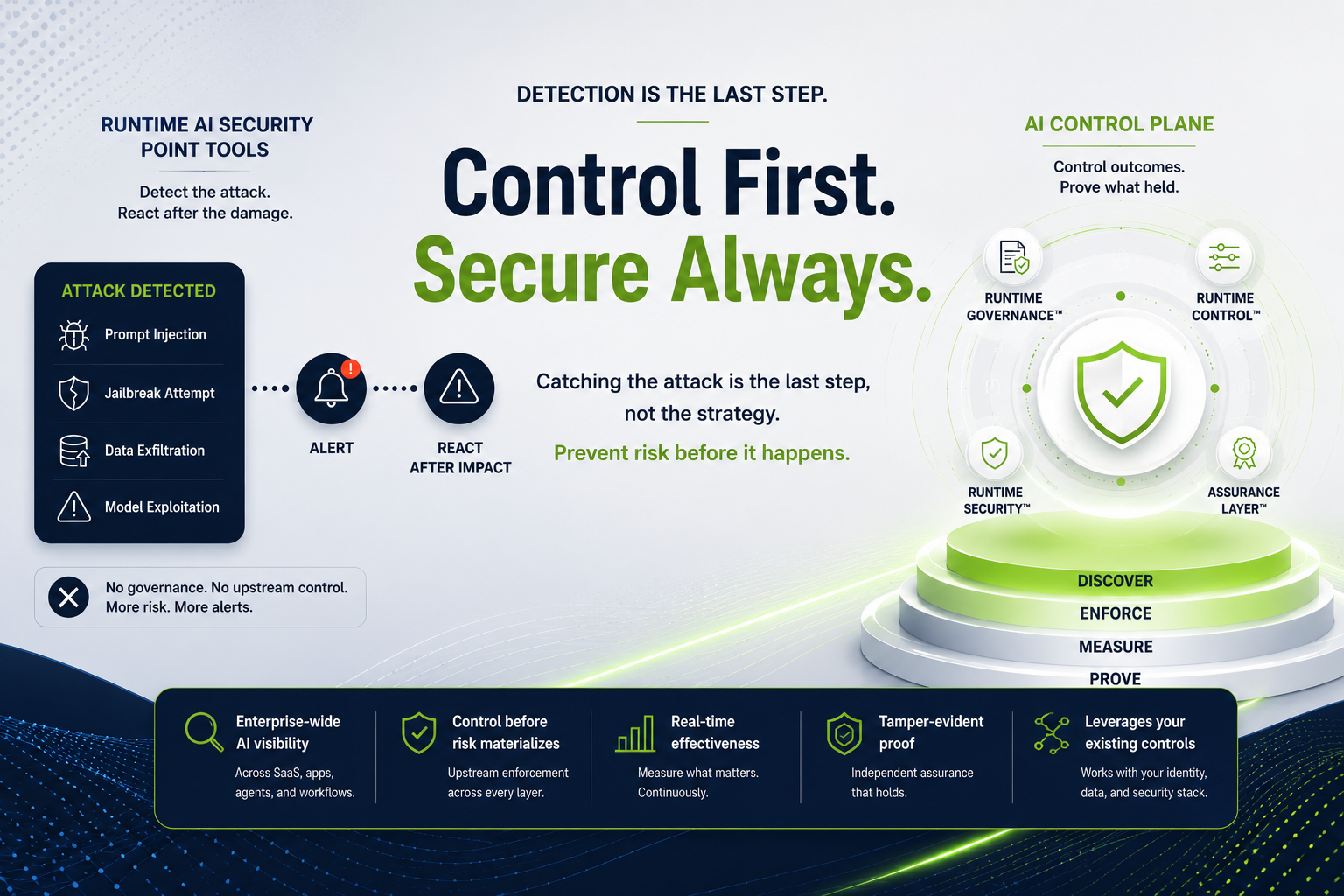
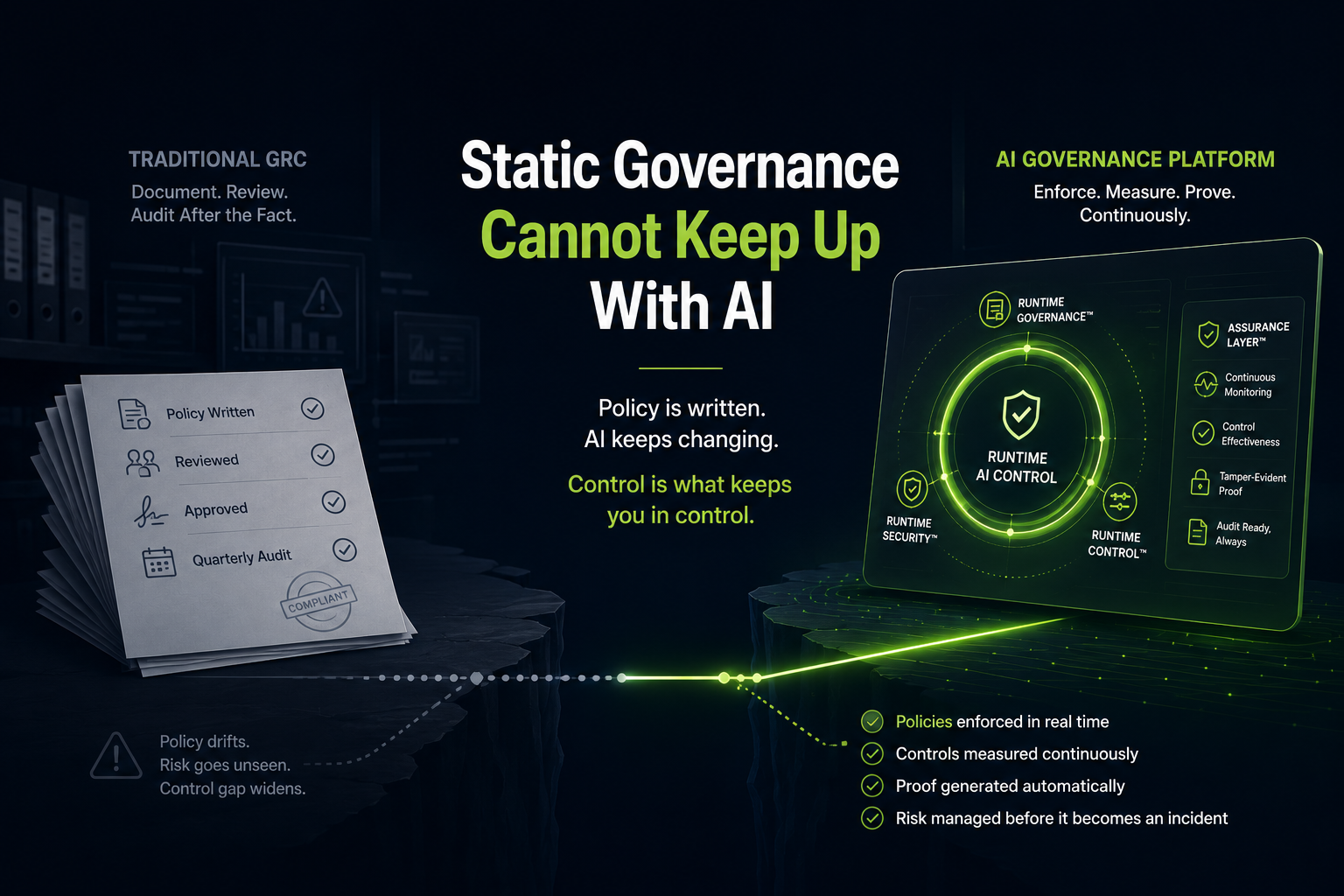
Policies written in documentation are not enough. Monitoring systems that observe behavior after the fact are not enough. Security tools that respond after something fails are not enough. When AI systems take action within enterprise systems, governance must operate in real time as those actions occur.
That requirement introduces a new layer of infrastructure for the enterprise.
From the beginning, Singulr has been built around a simple mission. Help enterprises adopt all forms of AI safely while maintaining control, accountability, and security across their environments.
The earliest wave of enterprise AI adoption centered on chatbots and copilots embedded in productivity platforms and SaaS applications. These systems introduced new risks around data exposure, policy violations, and unmanaged usage across organizations. Enterprises needed visibility into where AI was being used and how it interacted with enterprise data.
The next wave expanded beyond chat interfaces. Organizations began deploying foundation models, fine-tuned models, and internally developed AI applications integrated with business workflows. Governance had to evolve from simply observing usage to understanding models, applications, and the operational contexts in which they interacted with enterprise systems.
Today, the next phase is emerging. AI systems are becoming autonomous. Agents can invoke tools, retrieve information, call APIs, and execute tasks across enterprise environments. With the rise of agent frameworks and Model Context Protocol servers, the AI landscape is becoming an ecosystem of interconnected systems rather than a collection of isolated applications.
As AI expands across these layers, governance must evolve with it.
Many organizations believe they already have AI governance in place. In reality, most have policy frameworks and monitoring tools rather than operational enforcement.
Policies define intent, but they do not enforce themselves. Observability tools show what happened after an AI system has already taken action. Platform providers offer guardrails within their own ecosystems, but those protections rarely extend beyond their platform boundaries.
The critical question enterprises must answer is straightforward. When an AI system takes an action in a live environment, are the organization’s policies actually being enforced?
For many organizations today, the answer is uncertain. Governance exists in documentation, controls exist in configuration, and verification rarely occurs during runtime. As AI systems become more autonomous, this gap becomes increasingly dangerous.
Agentic AI introduces a fundamentally different operating model for enterprise systems. These systems no longer remain confined within a single application or platform. Instead, they move across environments, invoke tools, access data, and interact with multiple services as they complete tasks.
An agent might begin inside a cloud platform, retrieve information from a SaaS application, call an external API, and trigger a workflow in another system. Once this happens, governance embedded inside any single platform loses visibility over the complete interaction.
Industry analysts have begun highlighting this architectural challenge. Gartner recently noted in their market guide for Guardian Agents that organizations require independent oversight layers capable of supervising AI agents across clouds, platforms, and identity systems.
Vendor controls stop at vendor boundaries. The enterprise does not.
Every major technology shift creates a new layer of infrastructure. Cloud created the identity layer. SaaS created the CASB layer. Containers created the Kubernetes control layer.
Agentic AI now requires a similar evolution. A control plane for AI.
Enterprises need infrastructure that connects governance intent to operational enforcement across models, applications, agents, and enterprise data systems. This layer must continuously verify controls and enforce policies as AI systems interact with enterprise resources.
This is the role of the AI control plane. At Singulr, we believe this layer will become foundational infrastructure for every enterprise deploying AI.
The AI control plane sits between governance frameworks and operational environments. Governance teams define policies and acceptable use boundaries. Security teams focus on adversarial threats and incident response. AI platforms host models and agents that perform work.
The control plane connects these layers by translating governance intent into runtime enforcement. It continuously verifies that controls remain effective and ensures that AI systems operate within approved boundaries when interacting with enterprise resources.
Singulr was designed specifically for this role. Our platform connects governance policies to runtime enforcement across AI systems and agentic workflows, transforming governance from static documentation into measurable and enforceable operational control.
This approach allows organizations to innovate with AI while maintaining confidence that controls remain intact as systems evolve.
Agent Pulse extends the Singulr control plane into the rapidly growing ecosystem of autonomous agents. It allows enterprises to discover, govern, and enforce controls across autonomous agents operating in complex enterprise environments.
Agent Pulse provides four core capabilities:
Agent discovery
Continuous discovery and visibility into agents operating across platforms and environments, mapping how those agents interact with tools, systems, and enterprise data.
Agent risk intelligence
Dynamic evaluation of agent risk posture using model access, connected tools, and simulated adversarial testing.
Agent governance
Policy enforcement aligned to agent type, data sensitivity, operational scope, and acceptable use.
Runtime controls
Real-time enforcement to prevent unauthorized system access, prompt injection, unsafe or destructive tool access, and data leakage while agents execute tasks.
Governance becomes something that operates continuously rather than something that exists only in documentation or post-incident review. In other words, governance shifts from documentation to live operational control.
Many assume that hyperscalers or existing security platforms will eventually solve this problem. In practice, these systems have structural limitations.
Cloud providers govern AI systems operating inside their own platforms, but cannot fully supervise agents that interact across other environments. Security platforms detect adversarial threats but typically respond after actions occur. Observability tools capture behavior but do not enforce governance policies.
Analysts increasingly recognize that no single vendor platform can govern the entire enterprise AI ecosystem. Organizations must combine platform controls with independent oversight layers capable of spanning clouds, applications, and agent frameworks.
Independent governance ensures consistent enforcement across environments and prevents blind spots that arise when controls are tied to a single-vendor ecosystem.
The agentic enterprise is emerging rapidly. AI systems will coordinate workflows, interact with other agents, and automate increasingly complex business processes across organizations.
The companies that succeed in this era will not simply be those that deploy the most AI. They will be the ones that can operate AI safely, predictably, and at scale.
That requires infrastructure designed specifically for this new environment. The AI control plane provides that foundation by ensuring governance intent translates into real operational control across enterprise AI systems.
Agent Pulse represents the next step in Singulr’s journey to build this layer. As AI continues to evolve from copilots to models to autonomous agents, our mission remains the same.
Help enterprises adopt AI confidently, securely, and at scale.

Complete visibility across all three AI vectors in your environment, including agents and embedded SaaS AI

Singulr Pulse™ intelligence and the live risk signals that feed your control plane

Continuous red teaming, identifying control gaps and vulnerabilities in real time

Singulr Runtime Control™ enforcing governance intent without slowing innovation

.webp)