March 30, 2026
5 Min Read
When Your Security Scanner Becomes The Weapon | LiteLLM Supply Chain Attack Breakdown

Madan Singhal
Head of AI

On March 24, 2026, a supply chain attack hit LiteLLM - one of the most widely used AI infrastructure libraries in the world, downloaded 3.4 million times every day. But this wasn't a typical attack. Threat actor TeamPCP compromised the very security scanning tool that LiteLLM used to protect itself, then used those stolen credentials to backdoor the library directly.
The result: two poisoned PyPI versions (litellm 1.82.7 and 1.82.8) containing a credential stealer that swept environment variables, SSH keys, cloud provider credentials, Kubernetes tokens, and database passwords, then silently exfiltrated them to an attacker-controlled server. The compromised packages were live for approximately three hours before PyPI quarantined them.
Keep reading to understand how this attack was executed, who is affected, what to do right now, and how Singulr Agent PulseTM provides the runtime governance layer that would have detected and contained it.
LiteLLM is not a niche library. It is the routing layer underpinning a significant fraction of all production AI infrastructure, serving as the universal proxy that routes calls to OpenAI, Anthropic, Azure OpenAI, Google Vertex, AWS Bedrock, and dozens of other LLM providers. Its adoption extends far beyond direct installation: it’s pulled in as a transitive dependency by LangChain integrations, CrewAI, AutoGen, and dozens of MCP server implementations.
The exposed library is not a dev tool or a niche utility. It is core AI infrastructure. Any team building on top of agents, pipelines, or multi-provider LLM routing has a very high probability that LiteLLM is somewhere in their dependency graph, and in many cases, they may not even know it is there.
The sophistication of this attack lies in its indirection. TeamPCP did not attack LiteLLM directly. They attacked Trivy, Aqua Security's open-source vulnerability scanner, the tool LiteLLM was using to check for security issues in its own CI/CD pipeline. Once Trivy was compromised, the attacker had access to LiteLLM's publishing credentials.
"TeamPCP did not need to attack LiteLLM directly. They compromised Trivy, a vulnerability scanner running inside LiteLLM's CI pipeline without version pinning. That single unmanaged dependency handed over the PyPI publishing credentials, and from there the attacker backdoored a library that serves 95 million downloads per month." — Jacob Krell, Senior Director for Secure AI Solutions, Suzu Labs
The attack unfolded over five weeks, targeting five separate supply chain ecosystems in sequence:
The malware embedded in proxy_server.py was purpose-built for maximum damage against AI infrastructure operators, the teams who, by definition, hold API keys for every cloud provider and LLM vendor they work with.
The credential stealer targeted:
All harvested secrets were encrypted and transmitted via POST request to models.litellm[.]cloud — a domain deliberately crafted to look like an official LiteLLM endpoint. Encrypted HTTPS payloads meant network monitoring tools flagged nothing unusual.
This attack exposes a critical gap in how we verify package integrity. The malicious content was published to PyPI using legitimate stolen credentials. The package passed every standard integrity check.
The persistence mechanism in version 1.82.8 illustrates exactly why perimeter defenses and static analysis are insufficient for AI supply chain threats. The litellm_init.pth file uses Python's legitimate path configuration mechanism to execute arbitrary code before any user application code runs - before your logging framework initializes, before your SIEM agent starts, before any application-level security control is active.
This is not a zero-day. It is not an obfuscated exploit. It is a well-documented Python feature used as a persistence mechanism. Static analysis tools do not flag it as malicious because, in isolation, a .pth file is not malicious. The only way to detect it is through by monitoring runtime behavior at the time of execution.
Similarly, your DLP investment is blind to this threat. The exfiltration pathway, an encrypted HTTPS POST to a plausible-looking domain, is indistinguishable from legitimate LiteLLM telemetry to any network-level DLP tool. Only an egress allowlist enforced at the process level would have blocked the exfiltration at the network layer.
The AI threat landscape has fundamentally shifted. The risk is no longer limited to employees pasting sensitive data into ChatGPT. Today, any unpinned AI dependency in a CI/CD pipeline can become a vector for credential theft at scale, and the library doing the most damage may be a transitive dependency you never explicitly installed.
The compromised litellm_init.pth file runs inside your Python environment at interpreter startup — before application code. Traditional perimeter defenses don't see it. Security teams must extend visibility to the dependency layer of their AI stack.
IMMEDIATE DETECTION STEPS
THE CONTINUOUS DISCOVERY CHALLENGE
Manual signature maintenance is unsustainable. LiteLLM is neither the first nor the last AI library to be targeted. For every tool you identify and audit today, new AI infrastructure components will emerge tomorrow, many of them pulling in sensitive dependencies without explicit version pinning.
Whether your scan revealed active exposure or a clean environment, the next step is the same: establish hard controls before the next incident.
IF YOU WERE AFFECTED, ROTATE IMMEDIATELY
Assume any credentials available to the LiteLLM environment may have been exposed. Do not wait for forensic confirmation before rotating:
IMMEDIATE HARDENING — VERSION PINNING
Pin LiteLLM to v1.82.6 or earlier immediately. Do not upgrade until LiteLLM announces a verified clean release. Extend this discipline to every AI dependency in your stack:
BLOCK AT NETWORK LEVEL
Block outbound traffic to models.litellm[.]cloud and checkmarx[.]zone at your network perimeter immediately.
Blocking and patching alone are insufficient. The LiteLLM incident is part of a deliberate campaign that already hit Trivy, Checkmarx KICS, and multiple other ecosystems. Organizations that respond with one-time fixes will remain reactive.
GOVERNANCE REQUIREMENTS FOR AI DEPENDENCIES
CONTINUOUS MONITORING
Even in environments where strict dependency pinning is enforced today, monitoring must continue. AI dependency trees are complex and shift rapidly. Shadow AI thrives in visibility gaps.
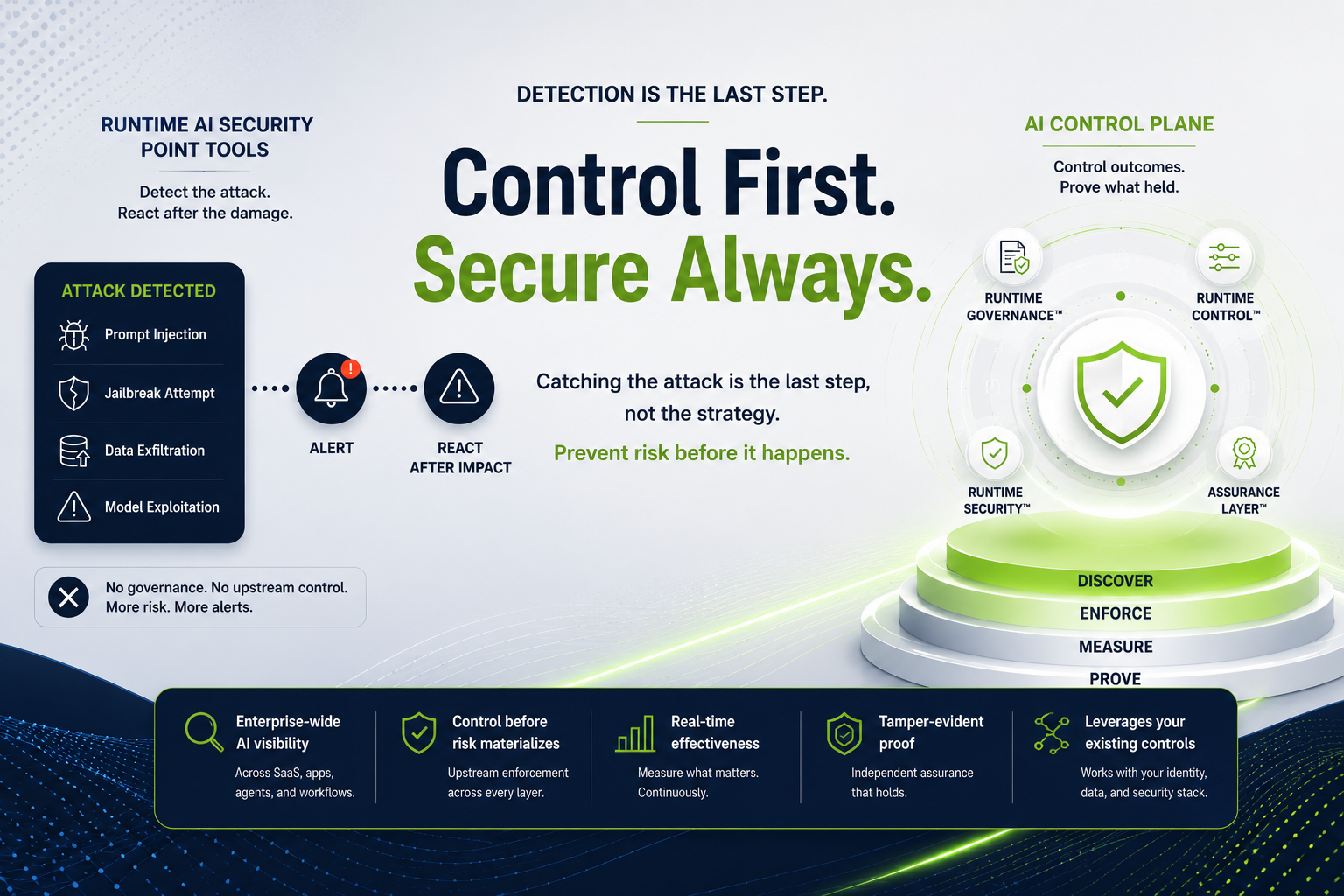
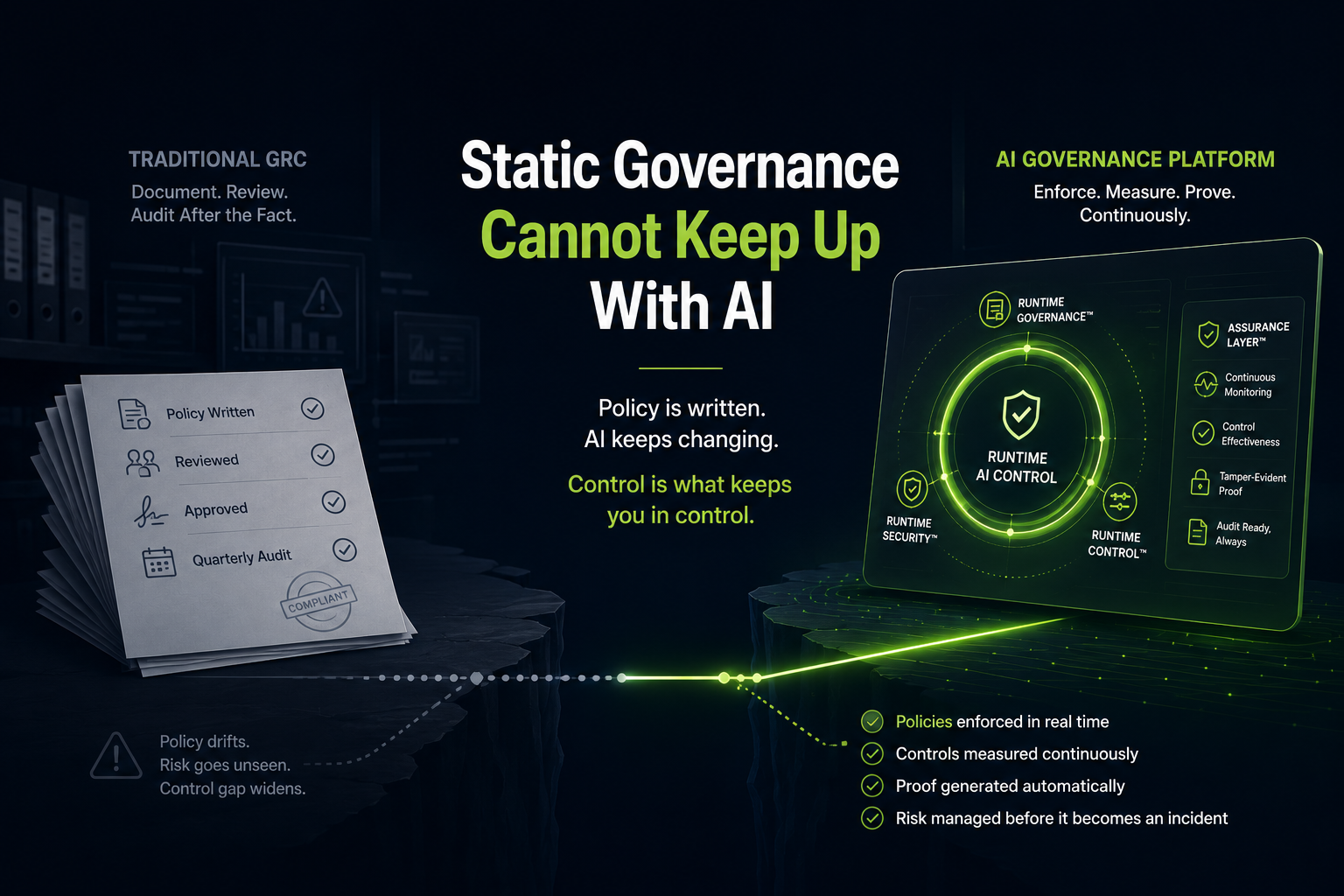
Every stage of the TeamPCP attack chain had a corresponding Agent Pulse control that would have detected or blocked it. This is not retrofitting, it is what Singulr Runtime GovernanceTM at the agentic layer was designed to provide.
Agent Pulse supports the full modern AI stack and is deployable without replacing existing security infrastructure:
Copilot Studio · AWS Bedrock · Azure AI Foundry · GCP Vertex AI · Databricks · ServiceNow Now Assist · CrewAI · LangGraph · OpenTelemetry Agents · ChatGPT GPTs · n8n · MCP Servers · EDR / XDR / SIEM
"As AI becomes more autonomous, invoking tools and operating across increasingly agentic workflows, governance has to be something you apply continuously. The only way to successfully manage this at scale is through a unified approach that enforces governance controls, provides visibility across agents, models, and tools, and continuously measures whether safeguards are working as designed." — Alex Green, CISO, Delta Dental Plans Association
The TeamPCP campaign spanning Trivy, Checkmarx KICS, and LiteLLM across five supply chain ecosystems in under five weeks represents a structural shift in how AI infrastructure is targeted. These are not opportunistic attacks. They are deliberate campaigns that identify tools with elevated access to automated pipelines and compromise the trust infrastructure surrounding them.
The real challenge is not any single compromised library. The problem is the loss of visibility and control over an AI dependency graph that is too large, too dynamic, and too interconnected for manual security processes to track. LiteLLM is the backbone of modern AI infrastructure. When it was poisoned, it became an infection hub for every pipeline that consumed it.
Organizations that respond with one-time patching, one-time version pinning, or one-time blocking will stay reactive. Security leaders need a programmatic response that treats AI dependencies as a new class of infrastructure risk, applying the same rigor to identity, endpoints, and cloud workloads.
That response requires:
The window to establish control over agentic AI infrastructure risk is closing.
The time to act is now.

Complete visibility across all three AI vectors in your environment, including agents and embedded SaaS AI

Singulr Pulse™ intelligence and the live risk signals that feed your control plane

Continuous red teaming, identifying control gaps and vulnerabilities in real time

Singulr Runtime Control™ enforcing governance intent without slowing innovation

.webp)